Business Operations Automation Pipeline
A Python service that automates order processing for a live multi-store delivery operation — syncing live status to Google Sheets, routing multi-warehouse fulfillment, and auto-generating customer invoices.
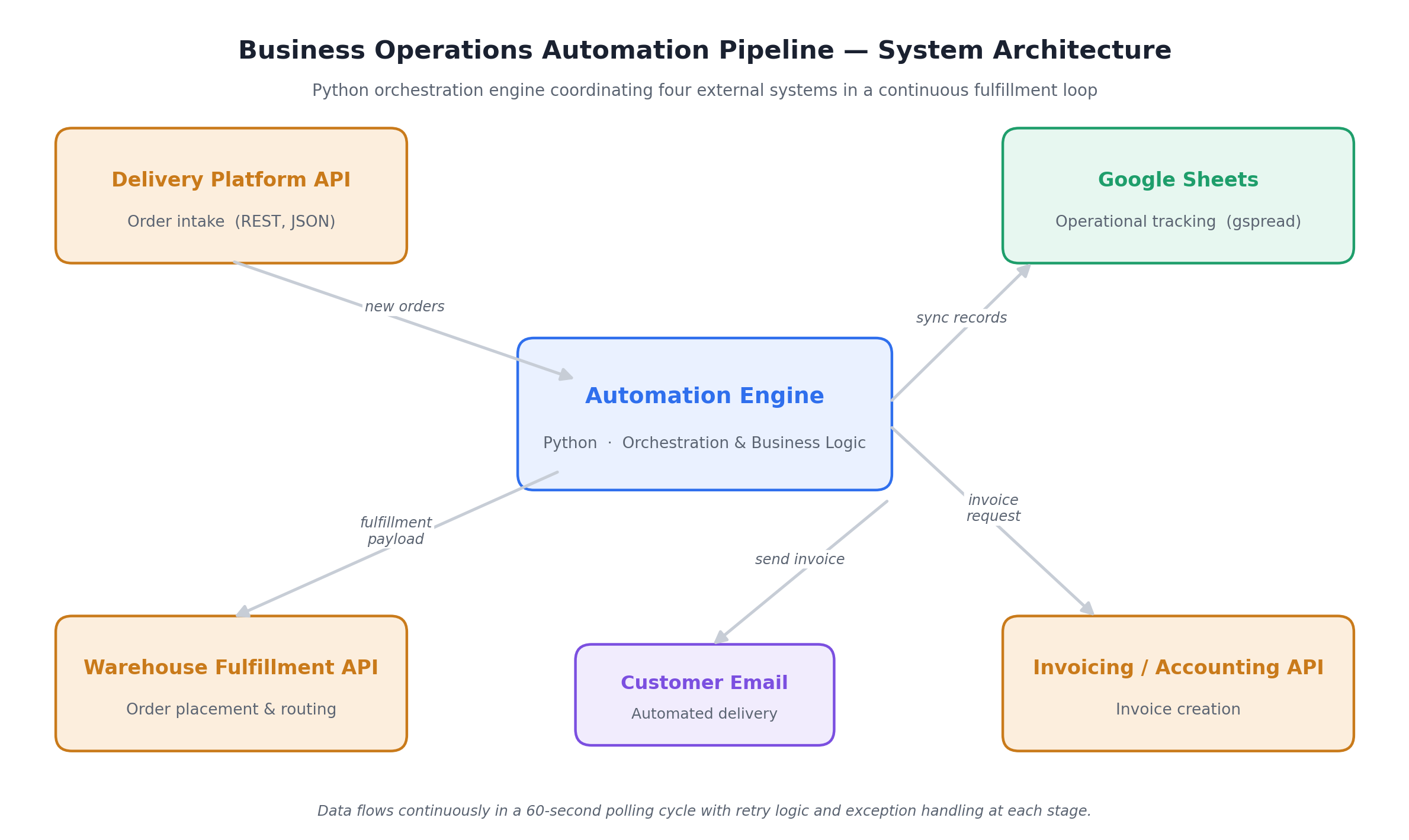
Repo: github.com/Ariful-tushar/rappi_order_automation_system Role: Python Developer (design, build, and deployment) Type: Production automation service for a live e-commerce delivery operation
Overview
A Python service that removes manual order handling from a multi-store delivery operation. It continuously watches a delivery-partner API for new orders, pulls customer and product details, keeps a live operational record in Google Sheets, routes each order to the correct warehouse for fulfillment, and generates and emails the customer invoice once the order is complete — all without a human touching the order in between. It runs as a persistent background service with automatic retry and error recovery, and coordinates fulfillment across 9 retail locations mapped to 6 separate warehouses.
Key Features
- Automated order monitoring — Polls the delivery-partner API on a continuous cycle, paginates through active orders, and detects new orders automatically by comparing against what's already tracked.
- Structured data extraction — Pulls customer info, delivery address, product line items, pricing, and SKUs out of nested JSON API responses and HTML page content (XPath), with safe fallback handling when fields are missing.
- Live operational tracking in Google Sheets — Every order, product line, status change, and invoice number is written to and read back from Google Sheets in real time, giving non-technical staff a live dashboard with zero manual entry.
- Multi-warehouse fulfillment routing — Automatically maps each order to the correct warehouse based on store location (8 distinct routing rules across locations) and submits a structured fulfillment payload to the warehouse management API.
- Automated invoicing and delivery — Looks up each product by SKU in the accounting platform's inventory, generates a compliant invoice, and emails it to the customer automatically once an order is marked complete.
- Full order lifecycle tracking — Tracks orders from intake through completion or cancellation, updating status, fulfillment confirmation, and invoice number back into the shared sheet as each stage finishes.
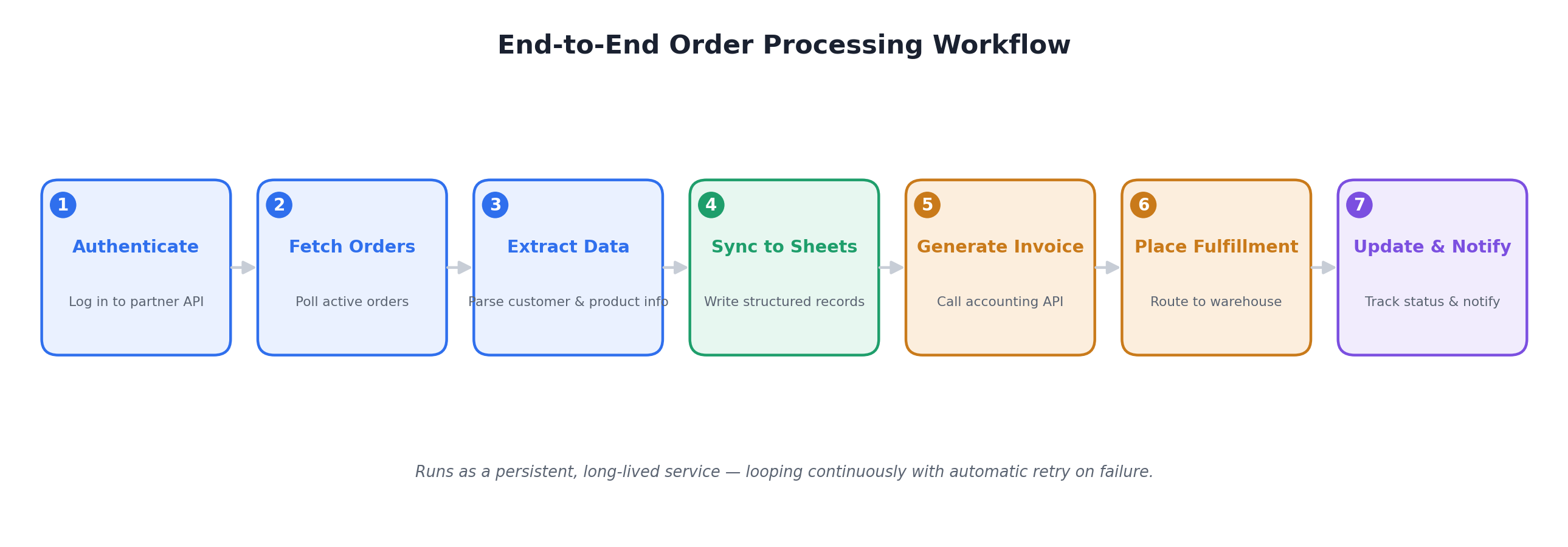
- Resilient long-running service — Runs in an infinite polling loop with a 60-second cycle, wrapped in exception handling and automatic restart logic so a single failed API call or network hiccup never stops the pipeline.
How It Works
- Authenticate with the delivery-partner API and the invoicing platform.
- Fetch all currently active orders across every tracked store.
- Extract customer, delivery, and product details for any order not yet on record.
- Write the new order and product data into Google Sheets.
- On each cycle, check for orders that have moved to a new status.
- When an order is marked complete: generate the invoice, place the warehouse fulfillment order, and email the customer.
- Write the resulting status, invoice number, and fulfillment confirmation back to the sheet.
See the architecture and workflow diagrams above for the system view and step-by-step flow.
Tech Stack & Skills Demonstrated
Core language & libraries
Python · requests · gspread (Google Sheets API) · lxml / XPath
Integration engineering REST API integration (GET/POST) across four independent third-party systems · JSON parsing of deeply nested, inconsistent API responses · session/token-based authentication · environment-variable-based credential management
Data & business logic Data normalization and validation across sources · SKU lookup and mapping logic with multi-level fallback · warehouse/location routing rules · order lifecycle and state management
Engineering practices
Exception handling and automatic retry at every external call · a persistent, self-recovering service loop suitable for unattended production use · modular design split across ingestion (main_file.py), fulfillment (order_place.py), and invoicing (invoice_creator.py)
Project Structure
project/
├── main_file.py          # Order monitoring, data extraction, Google Sheets sync, orchestration
├── order_place.py        # Warehouse routing logic and fulfillment API integration
├── invoice_creator.py    # SKU lookup, invoice generation, and customer email delivery
└── readme.md
Impact
- Eliminated manual order entry and status tracking across 9 active retail locations.
- Replaced manual invoice creation with a fully automated, error-checked generation-and-delivery step.
- Gave operations staff a real-time, no-code view of the entire order lifecycle through a live Google Sheet.