PropertyIQ — Self-Healing, AI-Scored Real Estate Data Intelligence Pipeline
A self-healing scraping pipeline that detects broken selectors, has an LLM rewrite them on the fly, and runs a second LLM pass to score and explain every real-estate listing it collects — with full audit logging in PostgreSQL.
Repo: github.com/Ariful-tushar/propertyIQ Role: Designer & Developer (architecture, scraping engine, AI agents, data layer) Type: Autonomous real estate data acquisition & analysis agent (personal portfolio project)
Overview
PropertyIQ is a scraping pipeline that fixes itself when a website changes. Instead of a fixed set of XPath/CSS selectors that break the moment a listing site redesigns its HTML, the pipeline detects the failure, hands a trimmed-down version of the page to an LLM, and lets the model write fresh selectors on the fly — then retries automatically. On top of that, every property that makes it through is passed to a second LLM step that scores the listing as a deal, writes a pros/cons summary, and stores both the raw data and the AI's reasoning in PostgreSQL, so nothing about how a decision was reached gets thrown away.
Key Features
- Automated source discovery — A dedicated discovery module locates property listing sources and URLs to feed into the scraping pipeline, rather than relying on a hardcoded list of sites.
- Resilient scraping engine — Built on Scrapy with Playwright integration (
scrapy-playwright) for full browser rendering, so JavaScript-heavy listing pages are handled the same as static ones. - Self-healing selector generation — A custom
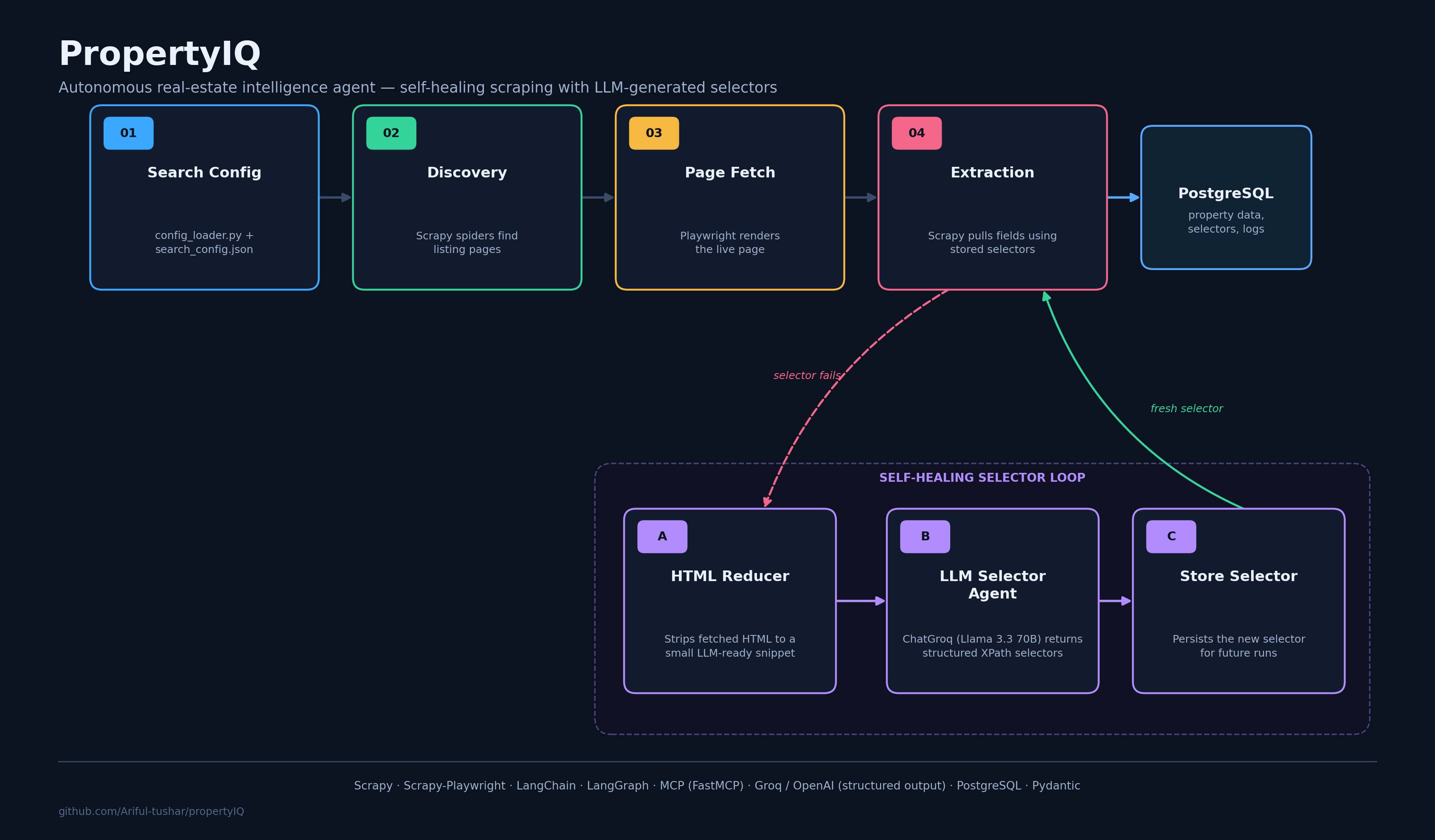
HtmlReducerForSelectorsengine compresses raw page HTML for LLM consumption: it strips scripts, styles, and tracking noise, keeps only the attributes that matter for writing a selector (id,class,data-*,aria-*,href), and collapses long runs of repeated sibling elements down to a representative sample — so the model sees the page's real structure without burning tokens on 50 near-identical product rows. When extraction fails, aSelectorAgent(LangChain + Groq's Llama 3.3 70B) reads that reduced HTML and returns fresh XPath selectors as validated, structured output — no manual fix required. - Schema-validated extraction — Every scraped record is parsed into a strict Pydantic model (
PropertyItem) before it's allowed anywhere near the database, catching malformed prices, URLs, or missing fields immediately. - AI-driven deal analysis — A separate LLM pass scores each property (0–100 deal score), assigns a recommendation label, and writes a plain-language summary with structured pros/cons — logged alongside the model name and prompt version used, so results stay reproducible and auditable as prompts evolve.
- Full pipeline observability — A dedicated
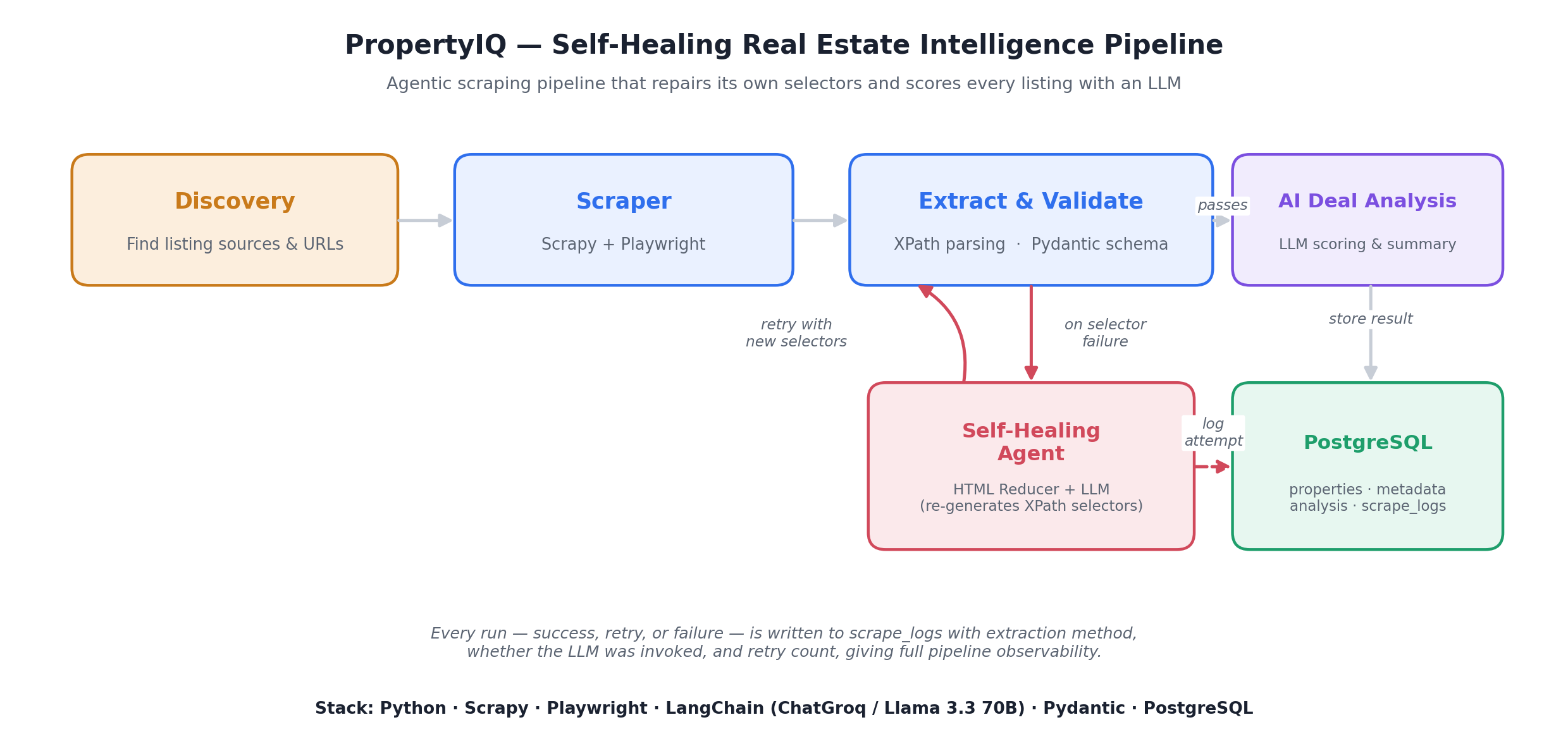
scrape_logstable records every run: the URL, extraction method used, whether the LLM was invoked, retry count, and any error type/message — turning "did the scraper work last night" into a one-query answer instead of a guess. - Structured, queryable storage — PostgreSQL schema separates raw listing data (
properties), AI-derived signals (property_metadata), and deal analysis (property_analysis) into distinct tables linked by foreign key, keeping scraped facts and AI opinions cleanly separated. - Containerized data layer — Ships with a
docker-compose.ymlthat spins up PostgreSQL and auto-applies the schema on first run, so the whole data layer is reproducible with one command.
How It Works
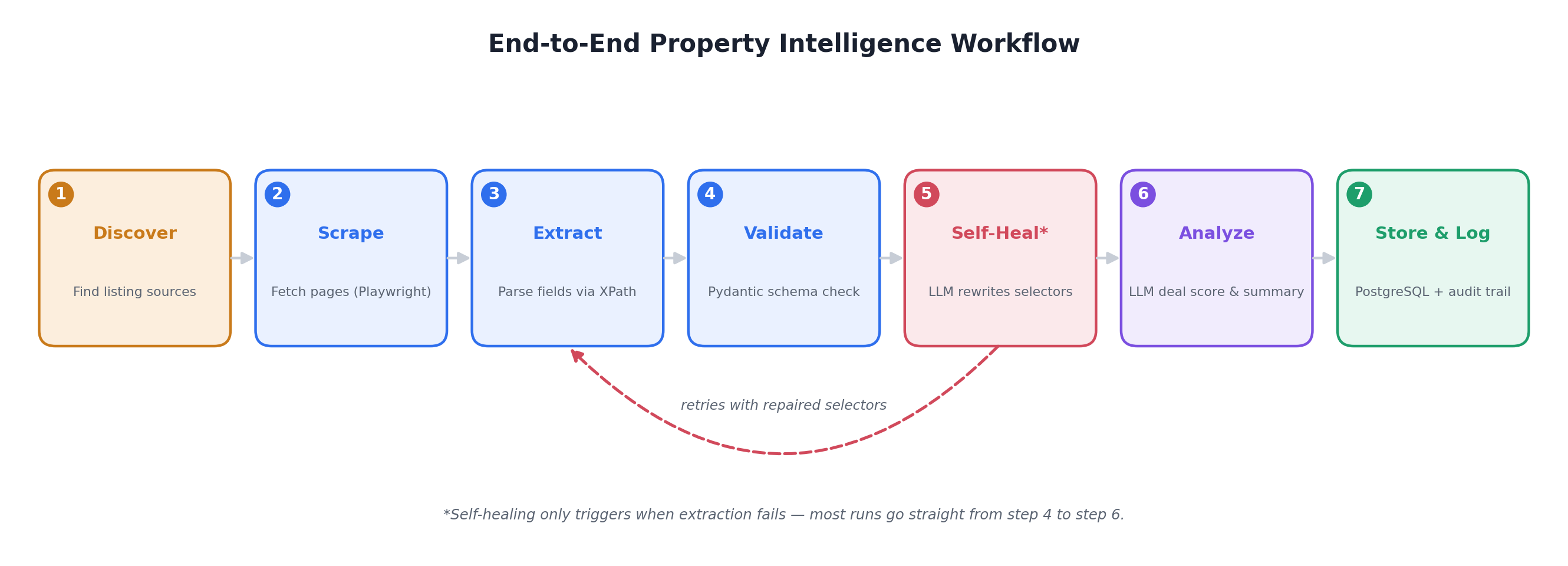
- Discover — identify property listing sources and candidate URLs.
- Scrape — fetch listing pages with Scrapy + Playwright.
- Extract — pull fields out using the current XPath selectors.
- Validate — parse the result into the
PropertyItemPydantic schema. - Self-heal (only on failure) — reduce the page HTML, ask the LLM to regenerate the broken selectors, and retry extraction.
- Analyze — an LLM scores the property, explains the reasoning, and produces a recommendation.
- Store & log — persist the property, its AI signals, and its analysis to PostgreSQL, and write a full record of the run to
scrape_logs.
See the architecture and workflow diagrams above — the first shows the component view (including the self-healing feedback loop), the second the linear step-by-step flow.
Tech Stack & Skills Demonstrated
Core language & data layer
Python · PostgreSQL (psycopg2) · Pydantic / pydantic-settings · Docker Compose
Scraping & browser automation
Scrapy · Playwright (scrapy-playwright) · lxml / XPath · parsel · cssselect · BeautifulSoup (for the HTML-reduction step)
AI / agentic engineering
LangChain · LangGraph (+ checkpointing) · LangSmith · Groq (Llama 3.3 70B via langchain-groq) · litellm · OpenAI SDK · instructor for structured LLM output · Model Context Protocol tooling (fastmcp, mcp) · prompt-versioned, structured LLM output for reproducible AI decisions
Engineering practices Self-healing failure recovery instead of hard-coded selectors that silently break · strict schema validation at the data boundary · full run-level observability and audit logging · clean separation of raw data, AI-derived signals, and AI analysis in the schema · modular architecture split across discovery, scraping, selector generation, LLM analysis, and storage layers
Project Structure
propertyIQ/
├── discovery/            # Finds property listing sources & URLs
├── scrapy_app/           # Scrapy + Playwright scraping spiders
├── selector_generator/   # HTML reduction for LLM-based selector writing
├── llm/                  # LLM agents — selector self-healing, deal analysis
├── schemas/              # Pydantic models (PropertyItem, SelectorResult, ...)
├── db/                   # PostgreSQL schema (properties, analysis, scrape_logs)
├── config/ / configs/    # Pipeline & environment configuration
├── scripts/              # Pipeline entry points / orchestration
├── tests/                # Test suite
└── docker-compose.yml    # One-command PostgreSQL data layer
Impact
- Removes the single biggest maintenance cost of any scraping project — manually rewriting selectors every time a target site changes its markup — by having the pipeline repair itself.
- Turns raw listing data into a scored, explained recommendation automatically, rather than leaving deal evaluation as a manual step.
- Gives full audit visibility into every scrape run (method used, retries, LLM involvement, errors), making the pipeline debuggable in production instead of a black box.